The Secret Language of Core Values
Why You Feel What You Feel (And What to Do About It)
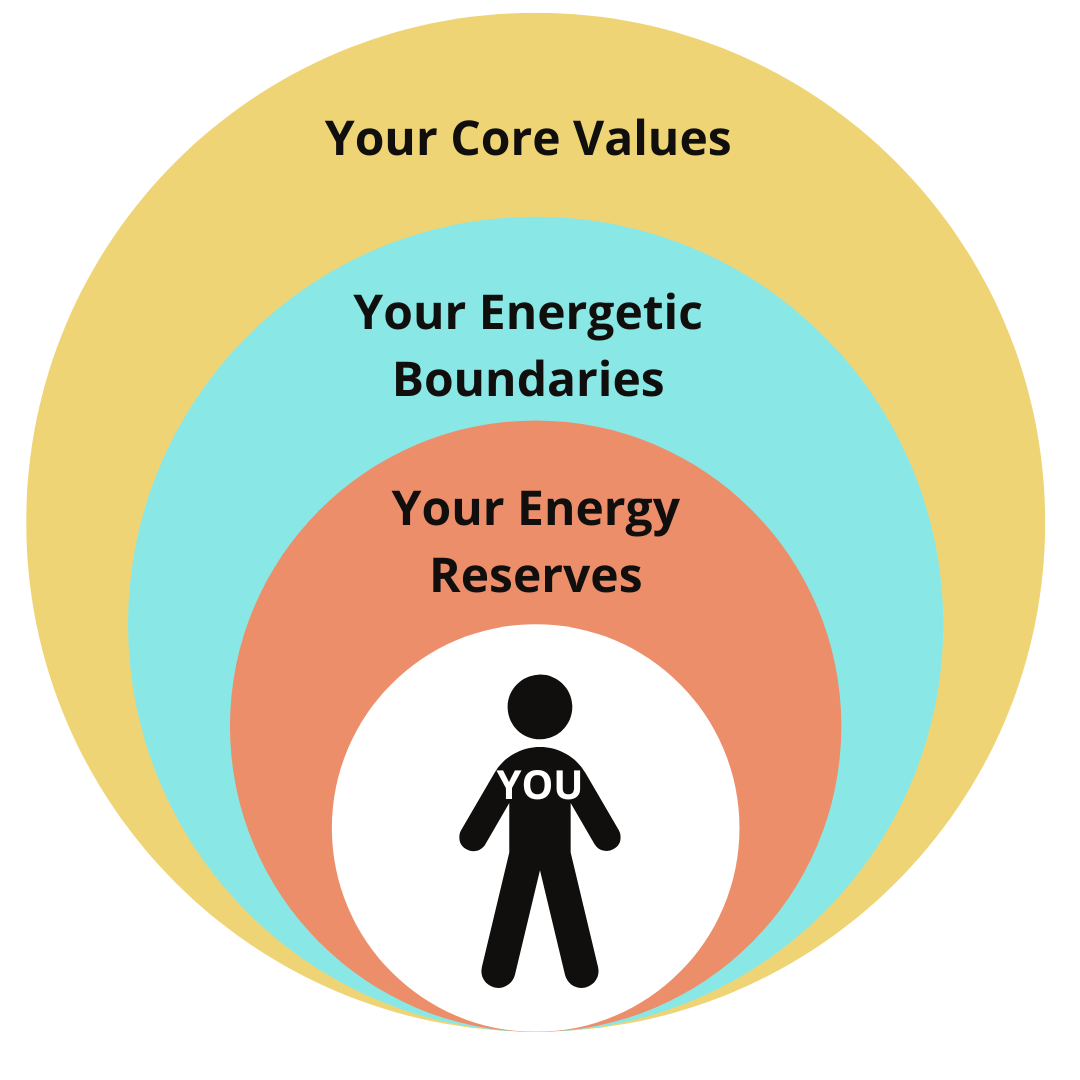
From Name, Claim & Reframe (p. 102) and the Name, Claim & Reframe Workbook (p. 33).
A client came to me furious about an hour.
The year before, she'd instituted a company-wide policy she genuinely believed in: no internal meetings after two o'clock on Fridays. Her people loved it. Eighty people got their Friday afternoons back, and somebody's kid got picked up on time for the first time in four years.
It had never once applied to her. The exceptions were all the things only she could decide, and they landed — reasonably, unavoidably — in the exact hour she'd protected for everyone else.
The Friday she called me, she had her bag on her shoulder when someone caught her in the hall with something that couldn't wait. She said of course. She always said of course. She sat in her car in the garage and cried for twenty minutes and could not have told you why.
That was what frightened her. Not the anger — the size of it. She'd built the thing. She could hardly go to her leadership team and confess she wanted the perk she'd handed out.
So we went looking for what the hour was actually taking.
It wasn't time. She had time. It was that she had built a door for eighty people and left herself standing outside of it. Every Friday at two, the whole company walked into something she'd made, and she stayed behind to hold it open.
She said it before I did. I gave everybody freedom except myself.
Once she had the word, the rage made sense. It wasn't disproportionate. It was exactly proportionate to something she'd never named.
That's what I want to talk about here: The language your values speak when they're being stepped on, and why it so rarely sounds like the thing it's actually about.
What Core Values Really Are (And Why They Matter More Than You Think)
Core values are not aspirations. They're not the words you'd put on a coffee mug or a company wall. They're not who you're trying to become. They're already operating. Right now. They've been running your reactions for years, whether or not you've ever said them out loud.Think of them as lighthouses. They're the signals that give you direction, meaning, and purpose. Beacons of truth. You don't build a lighthouse when the storm arrives — it was there the whole time. You just couldn't see it on a clear day.
Which is the first strange thing about values: you almost never notice them when they're being honored. A day where everything lines up doesn't announce itself. It just feels like a good day. Values reveal themselves in friction, not in peace.
The second thing worth knowing, and it comes from clinical psychology rather than coaching. In Acceptance and Commitment Therapy, values are treated as directions, not goals. (1) A goal is something you complete. A direction is something you head. You can check "get the promotion" off a list. You will never finish being a person of integrity — you can only point that way today, and then again tomorrow.
I find that enormously freeing, and I offer it to every client who arrives convinced they've failed at their own values. You haven't failed. You've been facing a direction. Some days you walk further than others.
The Anatomy of Energy Depletion
In Name, Claim & Reframe, I describe this as a set of concentric circles. At the center sit your core values. Around them, your energetic boundaries — the line where you decide what gets in. Around those, your energy reserves, the finite thing you spend every day on work and people and the small negotiations of being alive.
The circles are nested for a reason. A boundary is not a wall around your calendar. It's a wall around your values. Which is why a violation that looks small from the outside can drain you so completely — it didn't take an hour of your time, it went through the outer ring and touched the middle. This is also why the reluctant yes costs so much more than the task it commits you to. You didn't just agree to bake something for the fundraiser. You spent energy overriding your own center, and that override is the expensive part.
You can feel the difference in your body before you can explain it. On one side: pressured, stressed, resentful, drained. On the other: confident, at ease, peaceful, in flow. Notice that balance isn't the midpoint between those. Balance isn't neutral. Balance is a positive charge — and if you're aiming for merely not depleted, you've set the bar on the floor.
If this sounds soft, here's the part that isn't. Researchers at UCLA gave participants a genuinely stressful task — public speaking, mental arithmetic, an unimpressed panel. Beforehand, one group spent a few minutes writing about a personal value that mattered to them. That group's cortisol response was measurably lower than the group that didn't. (2) A few minutes of contact with what they cared about changed their body chemistry under pressure.
Your values aren't a nice idea you keep in a drawer for January. They're load-bearing. Disconnected from them, you're running your nervous system without its shock absorbers — and you will feel that long before you can articulate it.
When Your Values Are Under Attack
Your values rarely announce a violation. They send symptoms instead. Four to watch for:
Anger out of proportion to the event. The Friday meeting. The comment at dinner. If the reaction is bigger than the cause, the cause isn't the cause.
Feeling physically unwell before a particular interaction. Your body has a faster processor than your reasoning does. It has already run the numbers.
Saying "it's fine" when it isn't. The reassurance is for them. The cost is yours.
Resentment arriving the instant you agree. Not later. Not after the work. The moment the yes leaves your mouth.
Another client learned that one of her decisions had been reversed when a direct report stopped by to ask her about it.
He wasn't challenging her. He assumed she knew. He said something like just wanted to check how you want me to handle the rollout now — and she had maybe two seconds to decide whether to admit, to a person who reported to her, that she was hearing this from him. She said she'd get back to him. She kept her face still. He left. She sat there.
Her boss had made the call, told her team, and hadn't gotten around to telling her.
When she raised it, she got the chorus. He moves fast. From her peer. He didn't mean anything by it. From her mentor. Don't make this bigger than it is. From the one person she thought would be angry on her behalf. She spent the following week rehearsing what she'd say. She said none of it.
It was never about the decision. She might well have made the same call. It was about learning the shape of her own authority from someone standing on the other side of it.
The value was autonomy. And the tell was this: Everyone kept explaining his intentions to her, and nobody explained hers to him.
The Flip Side: When Your Values Are Honored
The trigger is one door in. Here's the other.
Think of a time you felt genuinely fulfilled — and be specific, not sentimental.
When did you feel truly seen?
When did something crack open with adventure or possibility?
When were you connected to something bigger than yourself? When did you make something beautiful and feel that particular satisfaction?
Honoring your values feels expansive and aligned. NOT honoring your values feels constrictive and wrong. Your body files this correctly long before your mind agrees to.
My Three, and What They Cost Me
I've been asking you to find your values. It's only fair I show you mine: Integrity. Altruism. Connection.
I didn't pick those off a list. They arrived over thirty-two years in education, a career change nobody in my family understood, and a great many quiet Tuesday afternoons where something in me said not this before my brain caught up. There's a distinction I find useful, from Brad Hook's work: some values are intrinsic — they live inside you and exist whether or not anyone is watching — and some are extrinsic, realized only through your impact on the world. (3)
Integrity is my intrinsic one. It's the quiet satisfaction of my actions matching my words in an empty room. Altruism is my extrinsic one — it doesn't exist in the abstract, only in the space between me and someone else. Connection sits on the bridge and satisfies both: the inward sense of belonging, and the outward work of building rooms where people feel safe enough to tell the truth.
When I started my coaching practice, I took every one-off session I could get. I was early in my certification journey and I needed the hours. People arrived with something real and left with language for it. It usually helped. But I wanted to help people see themselves in a new way — their blind spots, and where their hidden power had been living all along. You cannot do that in an hour. I knew it. I kept booking them anyway. Eventually I stopped. My calendar had holes I didn't enjoy looking at. Now I take clients who commit to the long arc, because it's the only version of this that does what I say it does. That wasn't a business decision that happened to feel good. It was integrity finally getting its way.
Here’s the part nobody puts on the inspirational graphic. Every value has a shadow, and the shadow is just the value turned all the way up. My integrity, overplayed, becomes rigidity — a woman who cannot let a small inconsistency go, at dinner, on a Sunday, for no useful reason. My altruism, overplayed, becomes self-erasure — I will hand you the last of my energy and then quietly resent you for accepting it. My connection, overplayed, becomes an inability to let a relationship be what it actually is instead of what I'd prefer it were.
So when I feel out of sorts now, I've stopped opening with which value is being violated? I ask a less flattering question first:
Is one of mine running unsupervised?
That question has saved me more grief than any boundary script I've ever written.
How to Discover YOUR Core Values
Two directions in. Work backwards from an upset, and forwards from a moment of aliveness.
Backwards. Take something that got to you this month — genuinely got to you, not just annoyed you. Then ask what was underneath it. Unfairness usually points to justice. Being talked over points to recognition. Being managed points to autonomy. Being rushed points to presence. The surface event is almost never the story.
Forwards. Find a moment you felt fully alive, and mine it. Who was there? What were you doing? What was true in that hour that isn't true most hours? One good memory will give you two or three values if you stay in it long enough.
Then — and only then — you may want a list. Here's mine: NCR Core Values List, a hundred-plus words to prime the pump.
But there is a trap if you stop there. In my Co-Active training, we were taught that values live in word strings, not single words (4) Two people both say freedom. For one it's freedom/independence/adventure. For the other it's freedom/self-expression/outrageous creativity. Same opening word, completely different lives. Hand either of them a checklist, let them tick "Freedom," and you've learned almost nothing.
So treat the list like a thesaurus, not a menu. Find the word that makes you sit up. Then keep going — what's beside it, what's under it — until the string is unmistakably yours and slightly embarrassing to say out loud. And don't feel obliged to stay inside the list. A client once named "cinnamon" as a value. It meant nothing to me. It meant everything to her, and naming it changed how she made decisions for the next year. Your job isn't to defend the word. It's to notice which one changes your face.
One last place to look.
There's a category of value you'll never find through your triggers, because nobody has ever taken it from you. It's so woven into your ordinary life that it's gone invisible — the air you breathe. (4) You find these by subtraction.
Ask: what have I never had to fight for? The friend who always picks up. The work that's always had a why. The one person you've never once had to explain yourself to.
Now imagine it gone. The thing that drops your stomach is a core value — often the deepest one you own, precisely because it's never had to make noise.
I'd rather you find those on purpose than the way most of us do.
When Your Own Values Collide
Everything so far assumes the problem is out there — a demanding manager, a dismissive mother-in-law, a soul-sucking job. The harder work is when your own values want opposite things on the same Tuesday. My integrity says tell her the truth. My connection says don't detonate the relationship. Both are mine. Both are real. There is no version of that afternoon where both get honored at full volume.
Most people take this as evidence they don't really know their values. They do. They've arrived at the place where values stop being a comfort and start being a decision.
And it turns out this isn't a personal failing — it's structural. Shalom Schwartz mapped human values across more than eighty countries and found they arrange themselves in a circle, where neighboring values reinforce each other and opposing values genuinely conflict. (5) Self-direction sits across from conformity. Achievement sits across from benevolence. The tension you're feeling is built into the architecture. Everyone's is. You don't resolve a values collision. You sequence it.
Ask which value, in this specific situation, would cost you more to abandon. Not in general. Not forever. Here. Honor that one out loud — and then find the smallest honest way to give the other one something.
For me it usually sounds like this: I tell her the truth (integrity), and I stay in the room afterward (connection). The truth still lands. The relationship still gets a witness. Neither value gets everything. Both get acknowledged.
That's not a compromise. That's the both/and doing its job — the Name and the Reframe holding hands instead of taking turns.
The Cost of Ignoring Your Values
Here's a version of a story I've heard more times than I can count. A woman stays in a corporate role three years past her expiration date because the benefits are excellent. Creativity is one of her top values, and it's dying a slow death in spreadsheets and status meetings.
She has an MFA. For years she took a Tuesday night painting class — the one thing on her calendar that had nothing to do with anyone else's deadline. She let it go the year the workload doubled, and told herself she'd pick it up again when things settled.
By the time she leaves, she has stress-related health issues and hasn't touched a brush in two years. Ask her what she was working on before she stopped, and she can't remember. Not I've been too busy. She sits there trying to recall the last thing she painted, and can't.
Three years of good benefits, and the bill comes anyway — just in a currency the benefits didn't cover.
Honoring your values is expensive. Ignoring them costs more. The difference is that the first bill arrives itemized and the second one arrives all at once, years later, with interest.
Saying YES When You Mean NO
A no is not a rejection of a person. It's a wall around your center. It is okay to say no when:
• You're stressed or overwhelmed
• You're already doing too much
• You're tired or sick
• It's genuinely someone else's problem
• You're feeling taken for granted
• You simply don't want to
• You'd rather be doing something else
• It steps on your values or your boundaries
• You deserve time that belongs to you
Read that list again and notice which one you're arguing with. That's the one worth looking at. If holding the line is the part that undoes you, I wrote a whole piece on it: The Power of Hell No.
Creating Energy Boundaries With Above-the-Line Behavior
From the Name, Claim & Reframe Workbook, two steps.
Name what's depleting you. Be unglamorous and specific. Not "work is a lot." The standing Thursday call. The group chat. The person who only reaches out when something's wrong.
Choose your energetic boundary. It usually takes one of three shapes — a kind refusal, a delayed response, or detachment from the outcome. That third one is the most underrated tool I know. You can go to the family dinner. You cannot control whether anyone behaves. Deciding in advance which of those is your job is a boundary, even though nobody else can see it.
Values-based leadership isn't about being nicer. It's about not spending your center to buy someone else's comfort.
What Becomes Possible
When you know your values, the decisions don't get easier. They get clearer — which is better, and worse, and ultimately the only thing that helps. You stop apologizing for reactions that used to embarrass you. You stop mistaking a values violation for a personality flaw. You start choosing on purpose, and you accept the bill for the choice, because you know what you bought.
Being honest with yourself is the harder path. It's also the only one that ends in peace.
Wishing you more clarity in all parts of your life,
🧭 Andrea
Chief Reframing Officer @ Beyond the Reframe
P.S. If you want a place to start, there's a Mini Value Reflection on page 97 of Name, Claim & Reframe. Or start right here, with the least flattering question in this whole piece: What did you say yes to this week that you meant no to — and which of your values is still waiting for you to notice?
Notes
1. On values as directions rather than goals, see the values literature in Acceptance and Commitment Therapy — reviewed in "A Systematic Review of Values Interventions in Acceptance and Commitment Therapy," International Journal of Psychology and Psychological Therapy 20, no. 3 (2020).
2. J. David Creswell, William T. Welch, Shelley E. Taylor, David K. Sherman, Tara L. Gruenewald, and Traci Mann, "Affirmation of Personal Values Buffers Neuroendocrine and Psychological Stress Responses," Psychological Science 16, no. 11 (2005): 846–851. Read the study
3. Bradley Hook, Start With Values: How to Build a Life with Meaning and Purpose (2024).
4. Adapted from "Fulfillment and Values," Co-Active® Coaching Fundamentals, © The Coaches Training Institute (now Co-Active Training Institute), coactive.com. I trained as a CPCC through Co-Active; the word-strings and invisible-values concepts come from that curriculum.
5. Shalom H. Schwartz, "An Overview of the Schwartz Theory of Basic Values," Online Readings in Psychology and Culture 2, no. 1 (2012).
Want to go deeper?
✧ Not sure where to start? Discover your leadership style in 2 minutes. [Take the Quiz]
✧ The Book: Where the methodology lives. [Get Your Copy] | [Listen on Audible] | [Get the Workbook]
✧ Conscious Leadership Kit: Bring NCR to your team — no coach required. [Shop Now]
✧ Private Coaching: Ready for the real work? [Schedule a Discovery Call]
I'm Andrea Mein DeWitt—a leadership coach, author, and self-proclaimed warrior in recovery who helps bold souls reclaim their power and unleash their full potential. After transforming my 32-year career in education into a dynamic coaching practice, I now guide people through my signature NAME, CLAIM AND REFRAME® methodology.
My book Name, Claim & Reframe: Your Path to a Well-Lived Life was featured on the TODAY Show as 2023's best motivational read. Writing from the foggy San Francisco Bay Area, I believe that life's challenges are invitations to discover who you're meant to be.